
Here you will discover the important items to consider when looking for a cat scratcher.
In addition, the types of cat trees with pros and cons, how to build, how to repair, and finally, what to do when your cat just refuses to use a cat scratcher.
It is important to understand that scratching is natural for cats. So even though we can trim cats' claws to reduce how sharp they are, and we can use cat claw caps to reduce damage to our furniture, we still need to provide an alternative scratching solution than our furniture.
There are several alternative scratching solutions available such as wall mounted, cat trees, cat posts (vertical and horizontal), etc Before deciding which one is right for you and your cat, it is also important to consider several factors or criteria that are relevant to selecting the best cat scratcher for your situation.
What to Consider When Selecting Your Cat Scratcher?
1. Your Cat
Individual likes and dislikes. Cats are individuals so it's crucial that you cater to their individual tastes, needs, and preferences. The article "A Review of the Housing Requirements of Domestic Cats" by Irene Rochlitz of Cambridge University recommends a suitable environment for cats to perform normal behaviors includes a variety of scratching materials in more than one location in their home.
What does your cat like? Some cats are active climbers and explorers, while others may be more comfortable in enclosed spaces and sleeping. Getting just any cat scratcher is only going to be the source of frustration for your cat. In addition to finding their favorite scratching material, structure, and location, the scratcher has to satisfy their specific needs if it is going to be more attractive than your furniture.
Horizontal vs Vertical. Remember that some cats are horizontal scratchers while others scratch vertically. Watch your cat to know what direction your cat likes to scratch. Reaching up high suggests a vertical scratcher, and scratching carpet or the base of your furniture suggests a horizontal scratcher. Some cats like both horizontal and vertical scratching.
Weight. If you have a cat that is 10 pounds (4.5 kg) or heavier, you must ensure that the scratcher and all its parts are strong enough to support the cat.
Age. Older "senior" cats (over 11 years of age) may find it hard to engage in physical activities, as most get arthritis by the age of ten. A younger cat would probably enjoy just about any style of cat tree. An older cat, however, might need something with more or larger platforms so it’s easier to climb up or they might prefer something closer to floor level. Young kittens, while very playful, may initially struggle to climb extreme heights but will also grow into a taller tree quickly.
Medical Considerations. Does your cat have any medical issues or allergies to consider?
2. Your Situation
Time and Effort. Take into account the time and effort required to assemble a scratcher as some are very complex and time consuming to construct. If too difficult, you may have a friend or family member who may be able to help. Also some scratchers (such as those made from cardboard) create a constant mess that you will have to regularly clean.
Accommodation. If you are renting a property, you might be limited in the type of scratcher you can install.
Medical Condition. Do you have an allergy to any scratcher materials or arthritis that could affect your choice of scratcher in terms of its size and/or weight?
Toxic Plants. Some potted and outdoor plants are extremely dangerous to your pets. You should ensure these toxic plants are removed from your cat's environment. In addition to these common plants (lilies, oleander, and tulips) here is a list of poisonous plants for cats but you should also check for plants that are specific to your region and country.
3. Scratching Material
Scratching material is one of the two most essential factors in training your cat to use a scratcher - the other factor being location which is discussed below. In order to have the most appealing furniture alternative scratcher, the material it's made of has to be your cat's preferred.
Different cats have distinctive scratching requirements. The material needs to make a good sound, allow the cat to sink its claws into it and offer the nooks and crannies that help trim the cat’s nails when scratching. You might want to buy an inexpensive cardboard scratcher or sisal scratcher initially to see what type of material your cat prefers.
Popular materials consist of cardboard, sisal rope, jute rope, carpeting, and wood.
- Cardboard is a great way to start. Cat owners often start with cardboard before trying out more costly and elaborate furnishings for their cats. On the downside, they create a large mess.
- Sisal rope is an all-natural textile created by combining fibers from the agave plant (Agave sisalana). It is truly safe to use and widely used in several sectors, from agriculture and interior design to nursery work. Sisal ropes are extremely popular, as they typically last for many years.
- Jute rope comes from the jute plant's stems and has a softer feel while sisal is a stiffer fiber, which makes it more sturdy.
- Carpet is loved by cats, especially looped as it provides resistance to their claws. Senior cats prefer carpet as it causes less pain on their older joints than rope based material.
- Wood is also a favorite for cats to scratch. Cat lovers often display stumps as decorative settings. You can buy a scratch post made of healthy logs, too. All things considered, scratching posts simulate modern trees that cats initially scratched to make themselves known to other cats and to mark their territory. Just make sure it is untreated wood and not toxic to your cat.
4. Location
Location, location, location! That is the catch-cry for real estate agents and it is the location of the scratcher that is important for your cat - more convenient to use rather than your furniture.
Placed at the wrong spot it may stay unused. You know your cat's favorite scratching spots, so place a scratcher within a few feet (1 meter). It can always be moved an inch or two every couple of days until in a location suitable for you and your cat.
An example of some cat scratchers and locations we use in our home are:
- A vertical scratcher near their sleeping location as they love to stretch and scratch on waking.
- Horizontal scratchers near the back of our couch and under the bed as an alternative to our furniture.
- A cat tree is situated near the window as they love to look out.
- A cat mat is spread out on the guest room floor as our two cats like to sleep there in the winter sun and then have a stretch when they wake up.
- We also use a cat friendly coffee table in our lounge room as they like to be close when we sit down for quiet rest.
Because cats are members of the family, do not confine them to specific rooms in the house. Just as you have a favorite chair or bed to sleep, you want your home to remain comfortable and inviting for you and your cat.
5. Height
A scratching post should be tall enough for your cat to scratch at full stretch.
How tall a cat tree or other wall shelf system you use depends on you and the height of your room. We deliberately keep tall scratching solutions away from our TV now since we found our kitten loved to use them as a way to step up to the TV and walk across the top of it. You may have fragile items or toxic plants on shelves that need to be protected.
According to one survey of 4331 respondents from the UK, Canada and USA, cats were less likely to scratch inappropriately if they had a simple upright post or a tree type scratcher of two or more levels at least 3 feet (1 metre) high. A taller post also keeps those joints and muscles healthy. Senior cats prefer low scratchers.
6. Safety
Stability. Choose a scratching post with a heavy, stable base so it doesn't wobble or topple during use. Stability is very important – cats will not use cat trees or vertical scratchers that wobble around, so pick one with a solid base. It’s essential to have a scratcher or a cat tree that's sturdy and durable.
Cat fights. Is yours a multi cat household? Do you need to purchase a large multi-level cat tree capable of holding all your cats or perhaps buy separate cat trees to avoid cat fights?
Accidents. Some scratchers come with toys like hanging balls, feathers, or bells attached. Whilst your cat may love to play with these items, they can be especially dangerous for unsupervised kittens as they may accidently get the string caught around their neck. We always cut these toys off the scratchers or shorten their hanging length to about 1-2 inches (5cm) maximum immediately after assembly.
7. Cost
Money. The amount of money you have available will help you decide on the following: whether to choose an expensive or inexpensive brand of scratcher; the number of scratchers to buy; the most suitable scratching material you want; the stability, and quality of the scratcher.
Experimenting with different materials, locations and types of scratchers will give you an idea of what your cat likes to do naturally. Work with your cat and you can both have a happy, stress-free life together.
Types of Cat Scratchers
Our objective here is to examine the different types of scratchers that will achieve:
- an immediate distraction from scratching your furniture; and
- a long term location that your cat loves and will find more convenient to use rather than your furniture.
We use several of these scratches:
- 2 Multi-Level Cat Trees - one beside the window providing an outside view, the other in our lounge for when we watch TV.
- 4 Horizontal Scratching Posts - all located next to lounge chairs or beds to provide alternative distractions
- Vertical Scratching Post - next to the screen door to encourage stretching up the post rather than the fly screen.
- Scratch Mat for Floor - in guest bedroom where they lie in the sun and love to have a good stretch upon waking.
The types presented below are examples of the most popular cat scratchers on Amazon.
Multi-Level Cat Scratching Trees / Condos
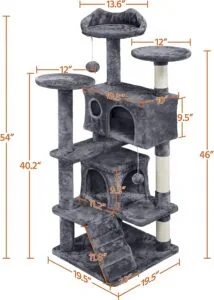
- There are a variety of cat trees / cat condo suitable for kittens to medium sized cats.
- Heights range from 33 inches to 76 inches (83cm - 193cm) with a large base to enhance the stability. Sometimes there is a anti-toppling strip attached so the tower can be secured to a wall.
- Each tower layout contains a variety of condo hut sizes, large perches, a soft hammock, interactive balls and a sisal covered ladder. All are designed to provide variety of interests and experiences for your cat/s.
- They are generally made from particle wood, supporting posts, natural sisal rope and soft plush coverings with rounded edges.
- A step-by-step instruction assembly manual is provided with tools where required. Support is available from supplier, if needed. Reviews suggest an average of 1 hour is required for assembly.
Multi-Level Scratching Trees / Condos for Large Cats
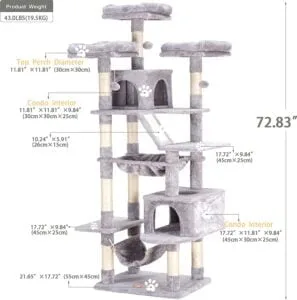
- These styles of cat trees are designed specifically for larger cats, both in size and weight.
- Whilst they are very similar in design and functionality to the cat tree above, the condos, hammocks, etc are suitable for the larger cat.
- A few reviewers commented on the importance of selecting a tree with condos, perches, hammocks, etc that were suitable for your cat size. Their cats (Maine Coon) couldn't fit.
Low Cost Cardboard Scratch Pad

- There are several inexpensive cat scratcher cardboard products on the market but this style of scratch pad is made from heavy duty recycled cardboard allowing extended use over others.
- Two sides can be scratched providing longer life and cost savings.
- The glue used is safe and non-toxic.
- The most frequent negative reviewers' comment was that cardboard scratch pads left a mess of little pieces of torn cardboard.
Sisal Scratching Mat
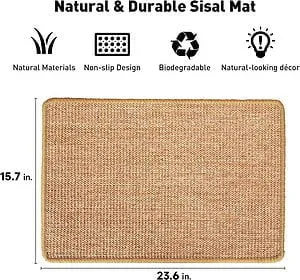
- Sisal Scratching Mats are safe, non-toxic and don't create a mess like cardboard pads.
- Whilst most of the over 10,000 reviewers are positive, some negatives are:
- too rough for their cat to lie on
- too small for very large cats
- moves too much when cat scratches
Vertical Scratching Post
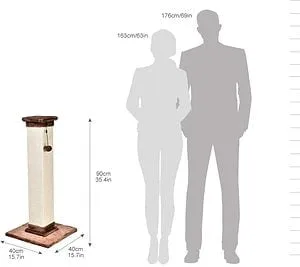
- A Vertical Cat Scratching Post has a large wooden base for stability and is covered with soft material.
- They vary in height but are generally 32 inches (81 cm) providing a good stretching post.
- Some cat scratch posts are square, others round and come in different colors.
- The tower is made from natural sisal.
- Some have a toy hanging from the top to encourage your cat to stretch fully.
- Construction is simple by screwing the top and base to the tower with the screws and tools provided.
Corner Scratching Post
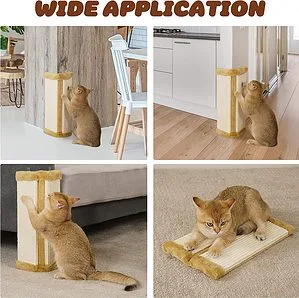
- This type of scratcher is primarily made for wall corners however reviewers also used it on bed corners and couches.
- The material used is natural sisal and plush.
- It comes with wall screws and Velcro stickers for your use. Some reviewers felt the Velcro strips weren't a suitable option as their cat was too aggressive and kept pulling the scratcher off the wall.
Scratch Mat for Side of Couch, Bed, Chair
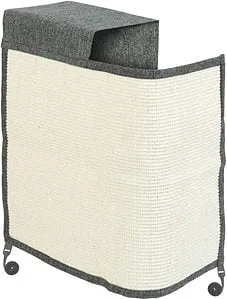
- There are several sofa protectors available but the Navaris Cat Scratch Mat Sofa Protector is the most popular sofa protector on Amazon.
- It is made from natural sisal with left and right armrests with a gray or brown fabric trim. A hook and loop fastener over the sofa's legs is used to hold it in place.
- Another popular cat sofa protector comes as a pack of transparent plastic pieces with self-adhesive pads and twist pins to secure it to your sofa.
Wall Mounted Shelf Set including Scratcher
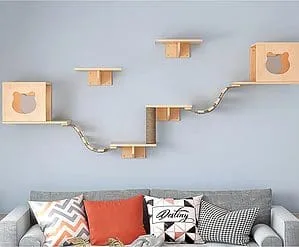
- Wall Mounted Cat Shelf Sets come as a box of parts. They have limited reviews because of the expense, need to assemble, and need to drill into walls to secure. DIY reviewers had no trouble but others said it was very difficult and took a long time to construct.
- Most reviewers were happy with the quality of the product and stated their cats loved to explore and climb all over it.
- Several wall mounted sets are available but this set offers a variety of options for your cat - 2 cat houses/condos, 4 cat shelves, 2 ladders and 1 scratching post. All made from solid pine and sisal.
Window Perch Cat Bed

- This is the number 1 Cat Window Perch on Amazon.
- It is cordless so safer for cats and no cords to chew. It is made from a stainless steel frame which is durable and stable from wind and heat.
- There are two washable and exchangeable covers. One is breathable mesh to dissipate heat whilst the other is a soft plush for warmth. Both are bite and scratch resistant.
- It can be installed on a window with 4 suction caps capable of supporting up to 30lbs (13kg) or fixed to a wall with anchors and screws.
How to Build your Own Scratcher?
Building a scratcher can be as simple as having used cardboard boxes from your local store. The downside is the daily mess of shredded cardboard pieces. Another simple option is to obtain an offcut of a tree limb from your local timber mill.
If you are handyman or know of someone who can help you, then these videos on how to build a do it yourself (DIY) scratching post or cat tree will be of great help. One video is about how to make a simple scratching post out of a piece of wood and some sisal rope. Another video is about how to make a more complex scratching post/cat tree using dowel rods, plywood, and carpet. There are many videos, narrated with clear, step-by-step instructions that are easy to follow. Pick one you think you can do and give it a go.
How to Repair your Cat Scratcher?
Replacing Sisal Rope
As a non DIY person, I found the process of repairing a cat scratcher easy and with the number of cat scratchers we have around our home, this is a very inexpensive solution.
There are many videos available however I found this one from CreativeProcessDIY very easy to follow to just replace the sisal rope without having to disassemble the scratcher. I also used a glue gun instead of the staple gun and 12 months later it is still holding together despite all the attempts at destruction.
Please accept the cookie consent
What if your Cat is Not Interested in a Scratcher?
Possible Reasons and Solutions
Here are the major reasons why your cat may not be interested in a scratcher:
Location - Maybe the scratcher is too close to people for a cat that prefers solitude or possibly too far away from you and other loved family members. Try moving it to a location where your cat spends a lot of time sleeping - they love to scratch when waking up. You could also try a different type of scratcher.
Materials. In some cases, cats develop preferences for specific materials. If you can’t get your cat to use the scratcher it may be the material is too different to your furniture. Try wrapping some similar material to your furniture on parts on the scratcher to encourage your cat to try it.
Age or health issues - Does your cat have a medical issue with its claws or paws? Does it have arthritis? Check with your veterinarian but also consider a scratcher closer to the ground like a mat or something softer to scratch like a cardboard scratcher.
Is your cat sensitive to change and stressed by something new being added to the household? Check out our Other Options below.
Type of Scratcher. Is the wrong type of scratcher in that location? For example a corner scratching post might be a better solution for a bed corner than a mat.
Safety Concern: If your cat had an accident like catching a claw, you may need to replace the scratcher. If the scratcher is unstable, you will need to make some adjustments to secure it.
Perhaps your cat is frightened because of a territorial issues with another cat in your household and another tree is necessary to avoid fights.
Other Options
Catnip. Rub quality catnip on the post to entice them to use it.
Play. Use treats and play with your cat around the scratcher to help redirect their energy away from your furniture and make the scratcher fun to be around.
Training. Check out the training your cat article for more ideas.
